
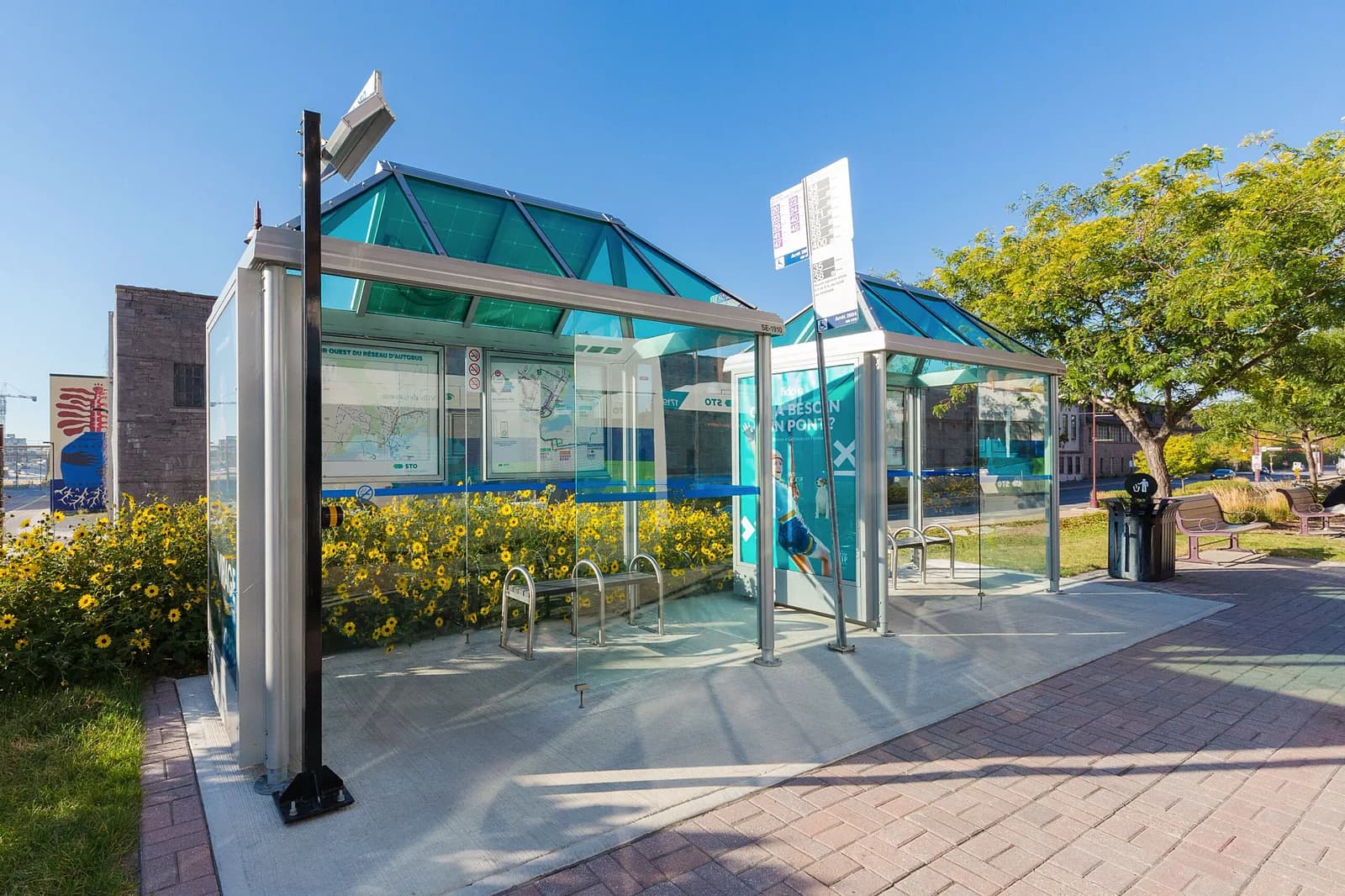
The decision between a solar-powered shelter and a grid-connected one looks at first like an engineering preference, but it's almost entirely a trenching cost call. The shelter electronics — lighting, real-time arrival, USB charging — draw similar power either way. What changes is whether you bury 30 metres of conduit and pay a utility connection fee, or whether you bolt a panel to the roof.
This piece walks through the off-grid math for the four Canadian latitudes that cover most procurement work — Toronto (43.6° N), Calgary (51.0° N), Edmonton (53.5° N), and Yellowknife (62.5° N) — and shows where the payback lands.
The starting point: load and duty cycle
A modest off-grid shelter draws roughly 20–35 W average: an 8–18 W LED on PIR motion control, an e-paper real-time display at 0.5 W average, and a small charge controller and modem at 5–8 W background. Across a 24-hour day at 50% PIR duty cycle, that's about 300–500 Wh per shelter per day — well inside what a single 200 W panel and a 100 Ah battery can deliver in southern Canada.
A more demanding shelter — backlit LCD instead of e-paper, USB-C charging on a steady duty cycle, optional Wi-Fi access point — bumps the load to 80–140 W average, or 2.0–3.4 kWh per day. That's where battery sizing gets real, and where Yellowknife stops working without panel oversize.
Peak sun hours by Canadian latitude
The metric that matters is December peak sun hours (PSH), not annual average. Solar systems sized to summer numbers fail in December when ridership and lighting demand peak. The December PSH numbers are blunt: Toronto 3.6 PSH, Calgary 2.5 PSH, Edmonton 1.8 PSH, Yellowknife 0.8 PSH. A panel that produces 200 W at noon delivers 720 Wh in Toronto's December and only 160 Wh in Yellowknife's.
For a modest 400 Wh/day load, that translates into panel sizes of 120 W in Toronto, 180 W in Calgary, 240 W in Edmonton, and 520 W in Yellowknife — roughly a 4× panel multiplier between southern Ontario and the territories. Battery sizes scale similarly because the autonomy required to ride out a 5-day cloud event is bigger when each clear day yields less recharge.
Trenching cost — the hidden line item
A grid-connected shelter on a typical Canadian arterial road needs 30 to 70 metres of conduit from the nearest utility transformer or pole, a service-drop hookup with the local utility, a panel and meter at the shelter, and the inspection-and-energization fee. Total: $4,000 to $12,000 for the trenching plus utility fees in the $500 to $2,000 range. On long-headway suburban routes where the nearest pole is 100+ metres away, the trenching number can hit $18,000 to $25,000.
That's the number to compare the solar-PV uplift against. Our solar configuration adds $1,500 to $3,500 to the standard shelter. So in the typical case, off-grid solar is $2,500 to $9,000 cheaper than trenched electrical at first cost — before you even factor the ongoing utility billing.
Payback math by latitude
For a Toronto rural-route shelter requiring 40 m of trenching ($6,500), solar configuration ($2,500 uplift) saves $4,000 capital plus $40/month utility (electrical billing for lighting) = $4,000 + $480/year. Payback is immediate at first cost; cumulative saving over a 15-year shelter life is roughly $11,200.
For a Yellowknife rural shelter requiring 60 m of trenching plus arctic permafrost factor ($14,000), the panel oversize bumps solar uplift to $5,500. Net first-cost saving is $8,500, plus utility billing avoidance of $60/month = $8,500 + $720/year. Cumulative saving over 15 years is roughly $19,300 — even with the $1,800 every-7-year battery replacement built in.
Where the math doesn't work
Solar doesn't pay when (1) the shelter sits 5 metres from an existing utility transformer (trenching is trivial), (2) the load is high enough that the battery becomes uneconomical (very large smart-shelter installs above 200 W average), or (3) the local AHJ doesn't permit off-grid lighting on a public ROW (rare, but worth checking). For everything else — most rural and suburban Canadian routes — the off-grid math wins.
Battery sizing and the autonomy buffer
Battery autonomy — the number of cloudy days the system rides through before drawing the battery below 50% state of charge — is the variable that makes off-grid shelters survive Canadian December. Industry practice is 3 days for southern sites with reliable winter sun and 5 days for northern and prairie sites where multi-day overcast events are common. A 400 Wh/day load with 3-day autonomy at 50% depth-of-discharge needs a 200 Ah / 12 V battery; the same load with 5-day autonomy needs 350 Ah. LiFePO₄ chemistry is the only practical battery for cold-climate shelters because it tolerates -20 °C operation when paired with a heated battery enclosure that draws 5 W to keep the cells above -10 °C during charging.
When to retrofit existing shelters
Many Canadian municipalities run shelter networks built in the 2000s with grid-tied lighting that's now nearing end-of-life. Retrofitting an existing shelter to off-grid solar is straightforward — pole-mount the panel on the rear vertical, wire to a small battery cabinet inside the shelter, swap the lighting controller. Retrofit cost is typically $2,800 to $4,200 per shelter versus $3,500 to $7,000 to renew a trenched-grid feed at end-of-utility-life — making solar retrofit a structural saving for any shelter past its first electrical-replacement cycle.
Related resources
- Solar-powered bus shelters — off-grid LED, heater and arrival-display configurations
- AODA-compliant accessible shelters — CSA B651-18 dimensional and contrast standards
- Bus shelter cost in Canada — full per-feature pricing breakdown
- Bus shelter RFP response — pre-qualified bid documentation
- Request a quote
FAQ
How long does a Canadian-spec bus shelter last?
Structure: 15–18 years. Tempered glass and bench surfaces: 5–8 years before refresh. Total cost of ownership lands at $1,000–$1,800 per shelter per year including maintenance.
Is AODA compliance required outside Ontario?
No, but every province has parallel legislation (RBQ Quebec, BC Accessibility Act, Manitoba, Nova Scotia, Newfoundland, plus federal ACA). We produce jurisdiction-specific documentation as part of every accessible-shelter order.
What lead time should I plan for?
Standard models: 6–8 weeks from PO. Custom architectural: 12–16 weeks. RFP-bid municipal projects: 5–10 working days for the response, install windows depend on the awarded schedule.