
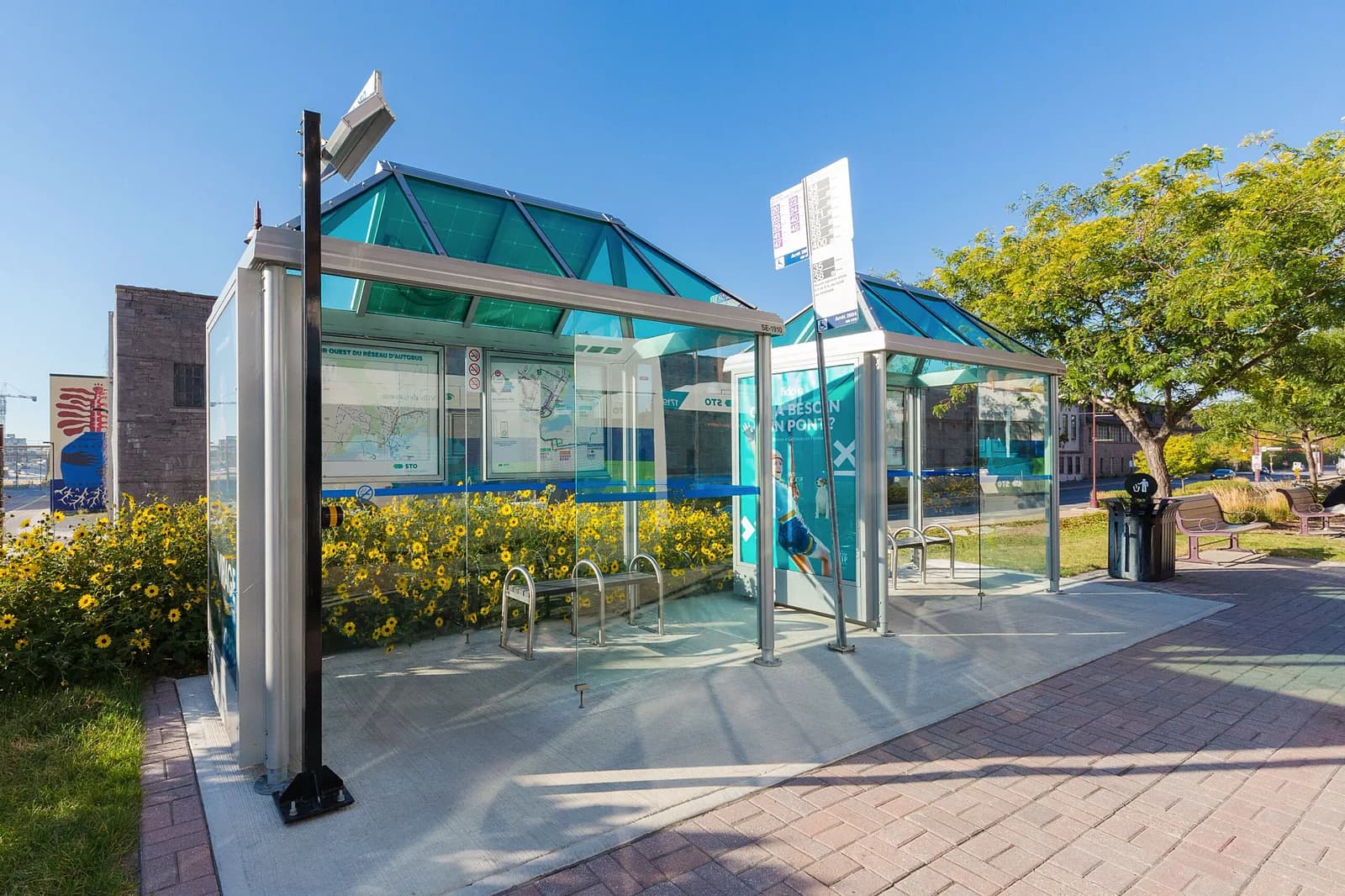
Solar-Powered Bus Shelters
Off-grid LED-lit shelters with rooftop PV array — no trenching, no electrical connection, full winter operation.
Solar-Powered Bus Shelters
Solar-powered bus shelters add a roof-mounted PV array, charge controller, and lithium-iron-phosphate (LiFePO₄) battery so the shelter runs lighting, real-time arrival displays, and USB charging without a grid connection. This is the right specification for routes where trenching power costs more than the shelter itself — rural stops, suburban park-and-rides, Indigenous community routes, and university shuttle loops.
Features & Specifications
About Solar-Powered Bus Shelters
Key Takeaways
- ✓Key features: 120–340 W monocrystalline PV panels sized to install latitude (Toronto 3.6 PSH → Yellowknife 0.8 PSH), LiFePO₄ battery 100–400 Ah with 3–5 days autonomy and heated enclosure for sub-arctic deployments, MPPT charge controller with Bluetooth telemetry and remote state-of-charge monitoring
- ✓Backed by a 5-year warranty
BusShelters. ca solar shelters use 120–340 W monocrystalline panels (mono-Si, 21–22% efficiency) sized to the latitude of the install site. A Toronto shelter at 43. 6° N sees roughly 3.
Solar-Powered Bus Shelters — Engineering & Construction
6 peak sun hours in December; a Yellowknife shelter at 62. 5° N sees 0. 8 hours and gets a 2. 5× panel oversize plus a heated battery enclosure.
Installation & Compliance
Battery capacity ranges from 100 Ah to 400 Ah at 12 V or 24 V, with 3–5 days of autonomy at the design-load duty cycle. The lighting load is a 4000K LED array drawing 8–18 W with a PIR motion sensor that lifts to full brightness when a rider approaches and dims to 20% standby otherwise. USB-C ports (5 V / 3 A) and Qi wireless pads are optional. Real-time arrival displays use e-paper (BWR, 0.
Warranty & Support
5 W average draw) rather than backlit LCD to keep duty-cycle inside the solar budget. The structure carries the same NBCC 2020 stamp as a standard shelter — snow load Ss, wind load q1/50, footings to local frost depth — plus a roof reinforcement to support the panel weight (18–28 kg per panel). Charge controllers are MPPT with Bluetooth telemetry; we ship a 5-year battery warranty and 25-year panel warranty. Solar shelters are deployed across Indigenous Services Canada community contracts, TransLink rural feeder routes, and Saskatchewan municipal procurements where prairie sun makes payback under 6 years.
Procurement & Lead Time
Solar shelter installation is 3–5 working days including PV mounting, battery commissioning, and remote-telemetry setup. Crews are licensed Master Electricians in the destination province (Red Seal Construction Electrician 309A in ON, Sceau Rouge équivalent in QC). Once installed, every shelter reports state-of-charge, panel output, load history, and ambient temperature to our hosted dashboard by default — free for the first year, $120/year per shelter thereafter, or self-host the open-source agent for free. Warranty is 25 years on PV panels (linear power output), 5 years on the LiFePO₄ battery (80% capacity retention), 3 years on the charge controller, 10 years on the structure, and 2 years on lighting and electronics.
Maintenance is minimal — annual panel cleaning and bi-annual battery state-of-health check — typically $200–$400 per shelter per year. Key Takeaway: Climate-rated, AODA-compliant, and stamped-engineered for Canadian transit deployment — full procurement documentation included.
Product Specifications
| Specification | Details |
|---|---|
| Product | Solar-Powered Bus Shelters |
| Frame & Glazing | 6063-T6 aluminum frame; 6 mm tempered safety glass to CSA Z97.1 (polycarbonate option) |
| Installation | Bonded crews, full traffic-management, 3–4 working days per site |
| Warranty | 10-year structural; 5-year glazing & bench; 48-hour replacement-parts SLA |
| Compliance | NBCC 2020 stamped engineering; AODA / CSA B651-18 accessibility |
| Lead Time | 6–10 weeks standard configurations; 8–14 weeks custom |
Why Choose Solar-Powered Bus Shelters?
Solar-Powered Bus Shelters from BusShelters.ca are engineered for Canadian transit conditions — climate-rated, accessibility-compliant, and shipped with full procurement documentation so AHJ review is single-pass.
Solar-Powered Bus Shelters Available Across Canada
We design, supply, and install solar-powered bus shelters in major cities across all 10 provinces and 3 territories.
Frequently Asked Questions About Solar-Powered Bus Shelters
How much does a bus shelter cost in Canada?
In Canada, standard freestanding bus shelters typically run $6,500–$14,000 for the structure plus $2,500–$6,000 for installation, including footings and electrical. Solar-powered units add $1,500–$3,500, and heated shelters add $3,000–$7,000 depending on heater wattage and bench heat. Custom architectural shelters for heritage districts or campuses can reach $25,000–$60,000+. Volume orders of 20+ units typically reduce per-unit pricing by 15–25%. Lifecycle cost is the better lens than first-cost: a stamped-engineered shelter with a 10-year structural warranty and a 48-hour parts SLA typically delivers a 15–18 year service life on the structure and 5–8 years on glazing and benches before refresh, which works out to roughly $1,000–$1,800 per shelter per year total cost of ownership including maintenance. Off-grid solar and heated configurations carry a higher first-cost but eliminate trenched-electrical and ongoing utility charges, which on rural sites pays back inside 6 years.
Can bus shelters be installed without a power connection?
Yes — our solar-powered models include a roof-mounted PV array, sealed gel battery, and LED lighting that runs autonomously through Canadian winter daylight. No trenching, no electrical permit, no service connection. Heated and smart-display models still require grid power or a higher-capacity solar+battery system; we'll size that to your site during quoting. The hidden cost saving on off-grid installs is the electrical-trenching avoidance: a typical grid-connected shelter requires $4,000–$12,000 of trenching, conduit, and service-drop work depending on the distance to the nearest utility pole or transformer, plus utility connection fees and ongoing electrical billing. A solar-PV configuration eliminates that cost entirely. For sites that need heat as well, our solar-heated combo carries a 1500 W heater on a 600 Ah / 48 V battery, suitable for 4-hour peak-commute heating windows at -20 °C without a grid feed.
Can I see a bus shelter in person before ordering?
Yes. Our showroom in Brantford, Ontario displays full-size production units of every product line. We also maintain installed reference sites in Toronto, Montreal, Vancouver, Calgary, and Halifax that prospective municipal clients can visit by appointment. Engineering and procurement teams can request stamped drawings and material samples shipped overnight. Our showroom in Brantford, Ontario has full-size examples of every product line — standard, solar, heated, accessible, smart, modular, and several custom-architectural pieces — set up as you'd see them on the street. We host site visits Monday–Friday 8am–5pm Eastern by appointment; group visits for transit-authority procurement teams are common and we'll co-ordinate the agenda with your team's schedule. For teams outside Ontario, we can also direct you to deployed-in-the-field reference sites in your region — most of our recent municipal installs have a public-right-of-way location available for inspection.
What warranty do BusShelters.ca products carry?
Standard warranty is 10 years on aluminum frames, 5 years on tempered glass and polycarbonate, 3 years on electrical and lighting components, and 2 years on solar batteries. Extended 15-year structural warranty is available with annual maintenance contract. All warranties are honoured Canada-wide with regional service depots. A summary of warranty terms across the product line: structural aluminum frame 10 years, glazing 5 years (manufacturing-defect breakage, not vandalism), bench 5 years, lighting 2 years, PV panels 25 years (linear power output), LiFePO₄ battery 5 years (80% capacity retention), heater element 3 years, smart-shelter electronics 3 years, cellular modem 5 years. Warranty registration happens automatically at install commissioning — no paperwork from your side. Claims are processed through our maintenance hotline 1-888-BUS-SHELT with a 48-hour response SLA on warranty-covered items.
Related shelters
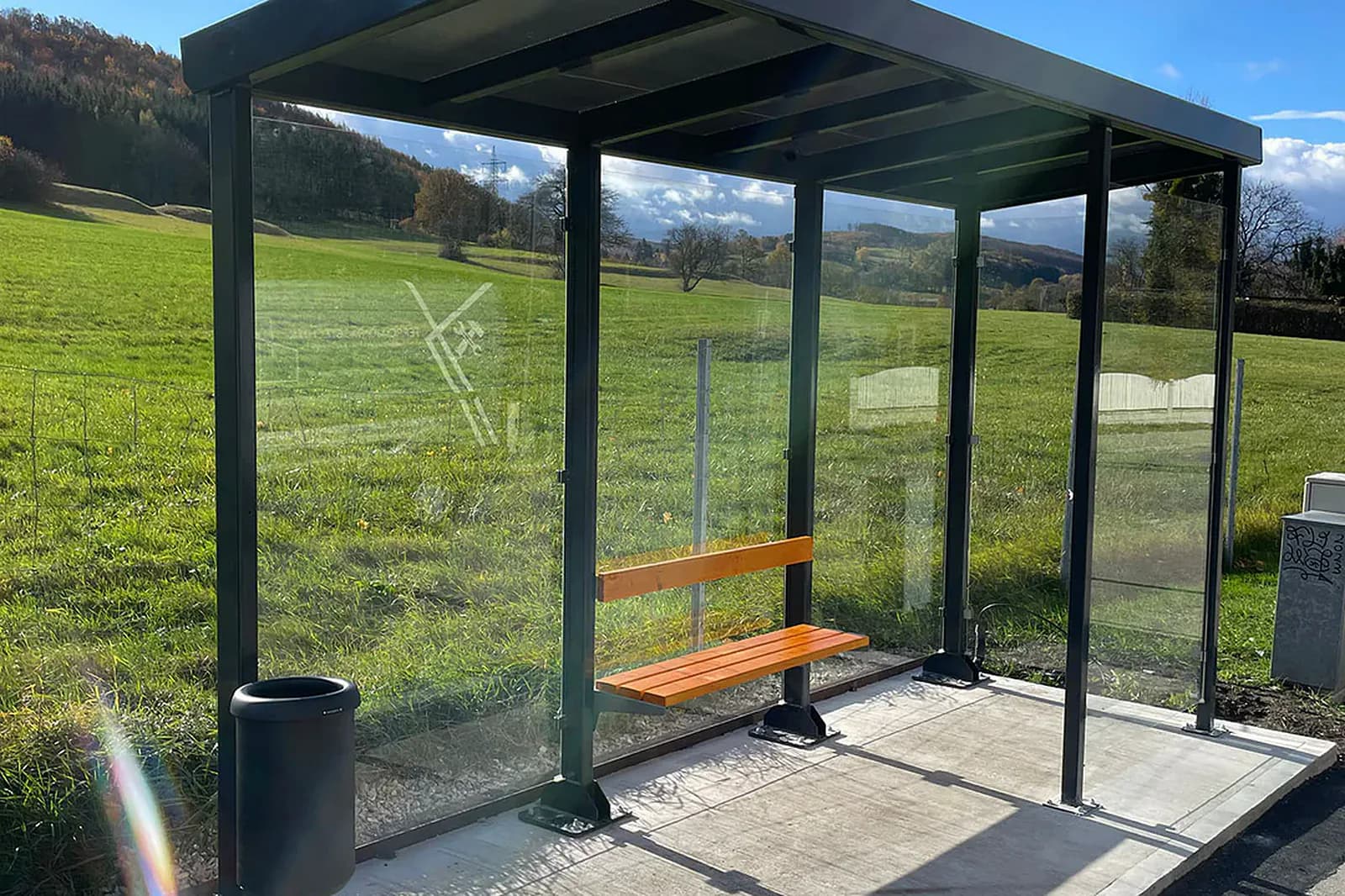
Standard Bus Shelters
Cantilever and freestanding bus shelters built for Canadian winters — tempered glass walls, anti-graffiti panels, integrated bench.
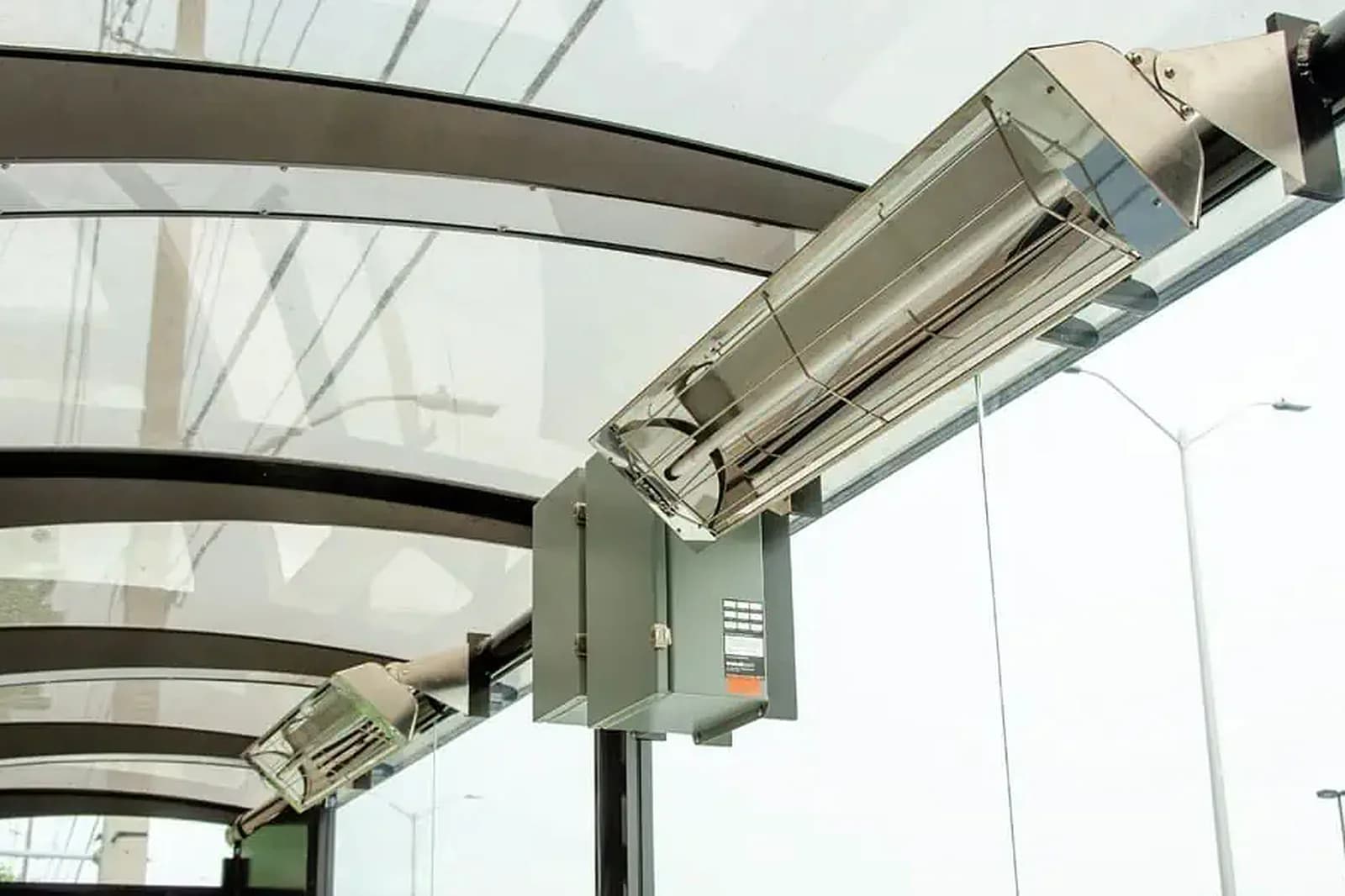
Heated Bus Shelters
Radiant overhead heating panels triggered by motion sensor — thermal comfort below -30°C, heated bench seat option.
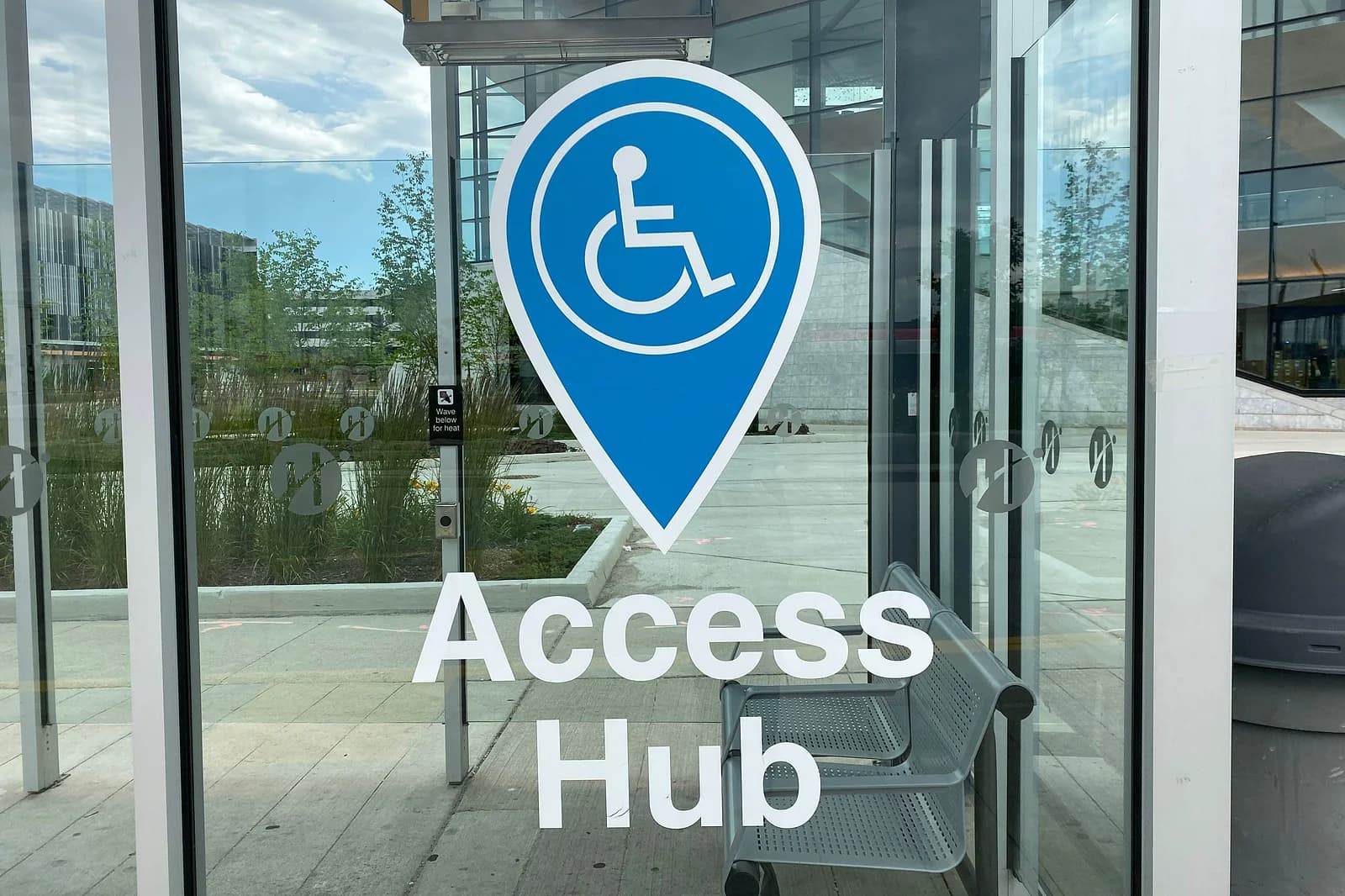
ADA & AODA Accessible Shelters
Wheelchair-clear floor space, transfer bench, tactile wayfinding, contrasting colour bands — meets AODA, BC Building Code Section 3.8, and CSA B651.
Need Solar-Powered Bus Shelters?
Our bid desk responds to every quote and RFP within one business day. Volume discounts available on 20+ unit orders.