
A Canadian bus shelter is engineered, not bought off a catalogue. Between Vancouver's 1.0 kPa snow load and St. John's 4.0+ kPa, between Calgary's 1.5 m frost depth and Yellowknife's 3.0 m, between AODA in Ontario and the BC Accessibility Act on the West Coast, the same nominal product gets a meaningfully different stamp on its drawings. This guide walks the major specification decisions a Canadian procurement officer faces, in the order they typically come up during an RFP technical-proposal review.
Snow load (Ss) — the structural starting point
Every Canadian shelter is engineered to the 1-in-50-year snow load (Ss) published by Natural Resources Canada in the NBCC 2020 Climatic Data Tables. The values run from 1.0 kPa in mild Pacific cities (Vancouver, Victoria, Tofino) to 4.0–4.5 kPa in St. John's, Sept-Îles, Saguenay, and parts of the Atlantic coast. The Prairies sit in the 2.0–2.8 kPa band; Ontario and southern Quebec mostly in 2.0–2.5 kPa; the territories range from 2.0 kPa (Whitehorse) to 3.5 kPa (Iqaluit).
Snow load is not the same as snowfall depth. A shelter in Saskatoon (250 cm annual snowfall, 1.6 kPa Ss) carries a lighter structural design load than a shelter in St. John's (320 cm snowfall, 4.0 kPa Ss) because Atlantic snow is wetter and accumulates with rain. The procurement spec should reference Ss in kPa, not cm of snowfall — the latter is meteorology, not engineering.
Wind load (q1/50) — coastal vs inland
Canadian wind loads run from 0.40 kPa in inland Calgary to 0.95 kPa on the St. John's coast. Coastal Atlantic and West Coast sites sit in the 0.65–0.95 band; the Prairies and Ontario sit in 0.40–0.50; northern sites scale to terrain exposure. Wind load drives the lateral-bracing connections and the glazing thickness — a 6 mm tempered pane that's perfectly safe in Calgary needs to step to 8 mm tempered or 6 mm laminated in Halifax for the same wind exposure.
Frost depth and footing design
Footing depth is a municipal engineering call, not a national-code one. The numbers are dramatic across Canada: 0.6 m in Vancouver and Victoria, 1.0 m in Hamilton and London, 1.2 m in Toronto, Ottawa, and Montréal, 1.5 m in Calgary and Saskatoon (mid-latitude), 2.0 m in Winnipeg, Edmonton, and Regina, 2.4 m in Yellowknife and Whitehorse, and up to 3.0 m in Iqaluit and the Arctic coast. Specifying a 1.2 m footing for a Winnipeg shelter is a guarantee of frost-heave failure within three years.
The procurement spec should require the supplier to provide stamped footing drawings for the destination city's frost depth — not a generic detail. Some municipalities also require pre-construction soil-bearing tests for shelters on reclaimed land or roadside fill; budget 2–3 weeks for that test cycle.
Heating spec — when, how, and at what cost
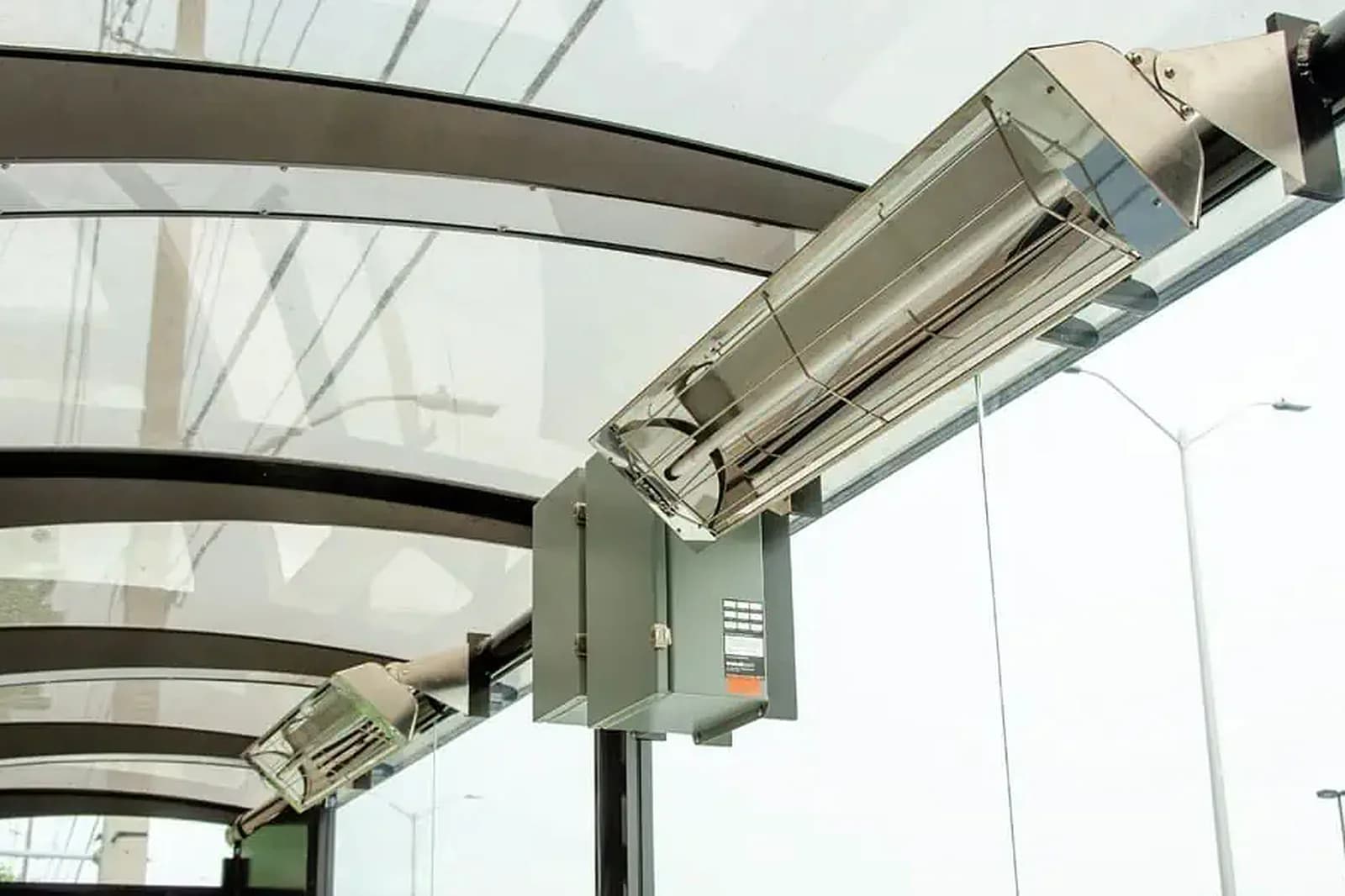
A shelter on a route with headway above 10 minutes in a city with January average temperatures below -15 °C is a heating candidate. That covers most of Canada from November through March. The choice between an 800 W, 1500 W, or 2400 W heater comes down to footprint, glazing, and design temperature. A 4 ft × 6 ft IGU shelter at -25 °C design temperature comfortably runs on 800 W; a 12 ft × 6 ft single-pane shelter at -35 °C needs the full 2400 W.
Operating cost is more reasonable than buyers expect. A 1500 W heater on PIR control at 40% duty cycle uses about 720 kWh per shelter per season at 8-hour winter days, or $94 per shelter per winter at $0.13/kWh commercial rate. The marginal capital cost of going from un-heated to heated is $3,000–$7,000; on a 15-year structure life that's $200–$470 per year amortized, plus the $94 operating cost — well inside the rider-comfort threshold for most decision-makers.
Accessibility — same product, different stamp
Every BusShelters.ca shelter is CSA B651-18 accessible by default. What changes by province is the documentation pack required to satisfy the accessibility-board review: AODA conformance letter in Ontario, RBQ Chapter VIII conformance in Quebec, BC Accessibility Act in British Columbia, and parallel attestations in Manitoba, Nova Scotia, and Newfoundland. The procurement spec should call out which provincial pack is required — once you know that, the rest of the accessibility decisions (tactile surfaces, contrast strips, hearing loop) flow from a standard menu.
What to put in the RFP technical clauses
Six clauses cover the climate-driven specification: (1) snow load Ss in kPa per the NBCC 2020 table for the destination city; (2) wind load q1/50 in kPa; (3) footing depth in metres matched to municipal frost-depth standard; (4) glazing spec — 6 mm tempered, 8 mm tempered, or laminated, with U-value and impact rating; (5) heating spec — wattage, control method (PIR / thermostat), bench-heat option; (6) accessibility documentation pack — provincial standard plus CSA B651-18 cross-reference. With those six clauses, your technical proposals will line up apples-to-apples.
Related resources
- Solar-powered bus shelters — off-grid LED, heater and arrival-display configurations
- AODA-compliant accessible shelters — CSA B651-18 dimensional and contrast standards
- Bus shelter cost in Canada — full per-feature pricing breakdown
- Bus shelter RFP response — pre-qualified bid documentation
- Request a quote
FAQ
How long does a Canadian-spec bus shelter last?
Structure: 15–18 years. Tempered glass and bench surfaces: 5–8 years before refresh. Total cost of ownership lands at $1,000–$1,800 per shelter per year including maintenance.
Is AODA compliance required outside Ontario?
No, but every province has parallel legislation (RBQ Quebec, BC Accessibility Act, Manitoba, Nova Scotia, Newfoundland, plus federal ACA). We produce jurisdiction-specific documentation as part of every accessible-shelter order.
What lead time should I plan for?
Standard models: 6–8 weeks from PO. Custom architectural: 12–16 weeks. RFP-bid municipal projects: 5–10 working days for the response, install windows depend on the awarded schedule.